
Assignments:
Hi All,
Thank you for joining in the course! In this course we will discuss how labeling and stereotyping our students affects them. Together we will also work on strategies to empower our students after they encounter such behaviors.
Assignment #1: What subject/area do you teach? What grade level? If you are not a teacher in the classroom, what is your position at your school? What is your definition of stereotyping and labeling? When you hear these terms what is the first thing you think about? Explain.
Assignment #2: What do you see as the main difference between stereotyping and labeling? Explain your thoughts in a few sentences.
Assignment #3:In your classroom, have you witnessed labeling or any form of stereotyping? Describe the situation and what occurred. I am a teacher in Brentwood and I see this alot of labeling with different Hispanic cultures. One culture such as a Dominican student will think he or she is better than a Puerto Rican student for example. They label their culture as better than the other.
Assignment #4: Read the following statement:
The impact of labelling:We define ourselves by our labels, and this can lead to self-limiting beliefs. Labels from childhood might affect future potential and how we see ourselves. If you use terms to describe yourself or others,
these terms may be “convincing” your brain that you or others are incapable of change.
After reading this statement, what do you think labeling can do to a person? A child? Do you really think it can truly affect someone? Share your thoughts.
Assignment #5: Read the following about the consequences of stereotypes.
What are the consequences of stereotypes?
- It’s so easy to see in an experiment.
- And so difficult to see in real life.
- Stereotypes influence how we think about other people.
- Stereotypes influence how we behave toward other people.
- Stereotypes perpetuate inequality and place a significant burden on those affected.
Think about the above statements and how people are truly affected and then have to deal with the consequences of stereotypes. Do you think that it changes how we think and feel about others? Explain. In addition, do you believe that sterotypes, whether you think you have them or not, cause you to behave differently towards certain people or groups? Be honest. I will not judge!
Assignment #6:
Name some things that you believe will help to overcome stereotypes? How do we rid ourselves of stereotypes? Is it possible? Thoughts?
Some would say…
- Educate yourself, meet new people and get the facts! Do you agree? Are there more you would like to add?
Assignment #7: Do you believe that that are advantages to stereotyping? Read the following: “Stereotypes can help individuals process information quickly by providing mental shortcuts. This can be useful in situations where quick judgments are necessary. Stereotypes can foster a sense of belonging and identity within groups.”
After reading the following, do you believe that there could be some good in stereotyping? Comment.
Assignment #8: Tell me a quick story of your upbringing and a stereotype or a label that has stayed with for years. Did you overcome it? Is is still with you? I grew up in a very Italian household. We were strict Catholics and my parents both grew up in Brooklyn and moved to Long Island after I was a few years old. My parents held many beliefs about many groups of people because of how and where they grew up. It took many many years to see that people could be good, friendly, and caring no matter who they were, what color, background or religion.
Assignment #9:
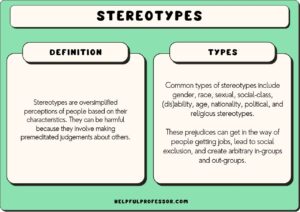
Read over the chart above. Review one of the stereotypes in the “types” box and describe how it has affected your colleges in the building where you teach. In my building, we have a lot of political issues that cause problems and issues with colleagues. It has even broken up many friendships. It is very sad.
Assignment #10: Reflection: Please reflect on the course and how you could use any of the information on stereotypes and/or labelling. Comment.
Thanks for joining in!
Talk to you soon,
Kim:)