
Hi All,
Thank you for taking the course! In this course we will discuss creative writing for all subjects of education. Creative writing provides our students with the skills to better reflect, research, read, and more. Using creative writing in any subject can be a valuable tool.
Assignment #1: What subject/area do you teach? What grade/s level? If you are not a teacher, what is your position at your school? Briefly explain the importance of creativity through writing in any subject. Thoughts?
Assignment # 2: Whatever subject you teach you should keep in mind the 5 “R’s” of Creative Writing. They are the following: real life, reflection, research, reading and (w)riting. Briefly explain how to use ONE of these in the subject you are already teaching. For me, reflection always fits in well with English. We reflect after we read, in our journals or at the beginning or class.
Assignment #3: Read over the “7 Types of Writers” that you may come across as you teach writing or do writing projects in your various subjects. Choose ONE of the types of writers and explain how this type of writer is held back by his or her writing style.
- GOOD UNDER PRESSURE WRITERS: You wait until right before the deadline before you start the writing project.
- FEAST AND FAMINE WRITERS: You pick a piece of writing to do for your project. You write every day; you are on fire. Then you put it down and forget about it. You pick it up again when you know it’s due and try to finish it.
- DAILY GRIND WRITERS: You write 500 good words a day for the project. You continue for several days until you have a full word count. Not bad if that is your style.
- LOTS OF FOLDERS WRITERS: These are writers who come with lots of little folders of writing, notes, files, folders. They gathered them over time. The problem is these don’t have a flow, and they are all over the place. Very disorganized….
- THE ‘OVER WRITERS’: A writer comes with a project that is 400,000 words long. Yikes. It has taken It has to be cut down. The problem is they often don’t want that. They love the process of writing but not revising!
- THE OVERTHINKERS: These writers agonize over every word. Each sentence is carefully crafted. Each paragraph is packed with information. This is useful, but it can hold you back. Most often these authors have too much information they want to share and are not sure how to pack it all in.
- NON-WRITERS: These are the writers who ‘think’ about writing, but don’t write very much. They never get the writing assignment done.
Assignment #4: Using the same list of “types of writers” from above choose ONE other type of writer of the 7 listed and describe how this style of writing might be helpful to a student who is trying to complete a writing assignment in any subject.
Assignment #5:
https://www.edutopia.org/article/why-students-should-write-all-subjects/
Read the above article about why students should write in all subjects. Review the 5 strategies to use in any subject. Think about different types of journaling, low stakes writing activities, student-created magazines, and creative writing/storytelling. Comment on this article, what you got out of it and how you could use any of these strategies in your classroom. I will always remember how my Social Studies teacher in 7th grade had us keep a history journal. It really helped me remember different periods of history and events.
Assignment #6:
Here are a few examples/techniques of how to use creative writing in different subjects:
Language Arts: Writing stories, poems, plays and other creative pieces.
Social Studies: Writing poems, short stories, raps, about social issues or explore different cultures through creative writing
Math: Use creative writing to explain mathematical concepts, such as writing a short story about a geometric shape or a mathematical puzzle
Science: Write a Science Fiction story about a new discovery or explore scientific concepts through poetry
History: Write a fictional diary entry from the perspective of a historical figure or create a short story set during a specific historical period.
Read the example above. Write about how you use one of these techniques in your classroom. If you have another one to share, please share it with me. If you teach a different subject, share the creative writing technique you use with your subject.
Assignment #7:
Look over the Creative Writing Prompts in the following image. choose ONE for the subject you teach and explain how you could use it as a Do Now for your lesson. Could you then expand this Do Now to a full creative writing lesson? Explain.
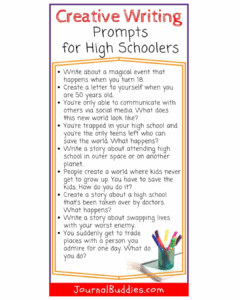
Assignment #8:
https://www.edutopia.org/article/50-writing-prompts-all-grade-levels-todd-finley/
Read over the following article on 50 Creative Writing Prompts for All Subjects. Share a few you could use with the subject you teach.
Assignment #9: Using the same article from assignment #8, choose ONE of the Creative Writing prompts and respond to it yourself. I’m interested! 🙂
Assignment #10: Reflection: Please reflect on the course and how you could use any of the strategies, examples or techniques for creative writing lessons with your students. Share how you can use them.
Thanks for joining in! Talk to you soon,
Kim:)