
Hi All,
Welcome and Class Description:
Thank you for joining my course! Working on effective tips for lifelong learning can lead to success and encourage positivity with your students. Effective tips to create lifelong learners includes: Cultivating a Growth Mindset, Teaching the Skill of Finding Answers, Allowing Choice & Personalize Learning, Embracing Mistakes as Learning Opportunities, Promoting Self-Directed Learning, Developing Critical Thinking & Curiosity and Modeling Lifelong Learning.
Directions for your coursework:
Please complete all coursework and send all responses to me in one email or document. Please be sure to put your name and title of the course on the document (email) when sent. Please reach out to me at any time with any questions or concerns. I am always here to help.
The course is divided into 10 assignments that have information, links, and valuable resources on the topic. I hope you enjoy the course and find that it is helpful, and you can apply it to your teaching or educational position.
Assignment #1: Introduction: Please introduce yourself. What subject/area do you teach? What grade level/s? If you are not a teacher, what is your position at your school? Share the makeup of your school. What is your classroom like like this year? Describe some of the skills you share at the beginning of the year and continue to use daily to promote lifelong learning. I have been a Brentwood educator for over 29 years, and we have adopted “Graduation Plus+” as a program in our district. It deals with our students and how Success Pathways, Growth Culture, Meaningful and Relevant Instruction and Assessment, and Empowered Stakeholders help the “whole student” become a lifelong learner. Briefly explain your current teaching situation and any vision statement your district might have.
Assignment # 2: Cultivating a Growth Mindset. Teach students that intelligence and abilities can grow through effort, viewing challenges as opportunities, not limitations, and that mistakes are vital stepping stones. When students know that they can have a growth mindset rather than a fixed mindset, they can go far! Read the following strategies:
- Praise Effort & Process, Not Just Talent: Instead of “You’re smart,” say, “I’m impressed by your hard work” or “That was a great strategy”.
- Embrace Challenges: View difficulties as opportunities to learn and grow, not threats to your intelligence.
- Use “Not Yet”: Frame failures as temporary states, indicating development is still in progress.
- Teach Brain Plasticity: Explain that the brain is like a muscle, growing stronger with practice and learning.
- Provide Constructive Feedback: Focus feedback on specific actions and strategies for improvement.
- Model a Growth Mindset: Show your own willingness to learn, struggle, and improve.
- Reframe Criticism: See feedback as valuable information for growth, not personal judgment.
In a brief paragraph describe some of the best ways you vary your teaching and cultivate your mindset in your classroom. What strategies do you use? Do you use any of the ones listed above? Explain.
Assignment #3: Teach the Skill of Finding Answers: Instead of just giving answers, guide students on how to find information using books, the internet, or experts, empowering them to become independent researchers.
In a brief paragraph, describe what you think about teaching the skill of helping your students with the art of finding answers. Every year I go over this skill with my students in the hopes that it will make their researching skills better. Some years it works better than others! What are your thoughts?
Assignment #4: Allow Choice & Personalize Learning: Offer choices in topics, projects, and materials to connect learning with students’ genuine interests, making education more engaging and self-driven.
In a brief paragraph, describe how important you think it is for students to have a choice with work. Do you provide your students with meaningful choices on assignments? Do you have them comment on why they chose that assignment over another? Do you believe that this helps with student ownership of work? Interest in the work? Explain.
Assignment #5: Embrace Mistakes as Learning Opportunities: Reframe errors as essential parts of the learning process, analyzing them together to understand why they happened and how to improve.
In a brief paragraph, describe how making mistakes can help your students learn and how this is a lifelong skill and can help them. Explain a mistake you have made that you could use as an example for your students in their learning process. For me, I always discuss the mistake I “almost made” not to come to Brentwood. If I chose to stay in a different district I would I have never had the wonderful teaching experience I have today!
Assignment #6: Promote Self-Directed Learning: Encourage students to set their own learning goals and take ownership of their education, fostering autonomy and intrinsic motivation.
Think about the ways in which you encourage your students to set their own learning goals in class. Do you ask them to define a specific goal first? Or do you start with “what is our goal”? (depending on what they know they are weak in) Does goal setting vary from year to year depending on the specific students you have? This year I have a group that works well on reading comprehension. Our goal is to work together on understanding what we read and discussing it. Then we answer questions right away for understanding. Explain your theory for self-directed learning.
Assignment #7: Develop Critical Thinking & Curiosity: Design activities that require analysis, problem-solving, and questioning, transforming students from passive recipients to active, curious thinkers.
Think about the ways in which you help your students to develop critical thinking skills in your classroom. What activities do you use to help foster curiosity? How do you think these skills help your students question and problem-sovle better? How does this help them to be active thinkers? Explain.
Assignment #8: Model Lifelong Learning: Share your own learning journey, what you’re curious about, and how you find answers, demonstrating that learning never stops.
Briefly describe how you as a teacher, are always learning. Discuss the ways you would explain to your students the importance of lifelong learning?
Assignment #9: 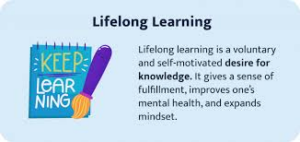
Look at the about picture. Describe briefly how important it is for students to have the desire and motivation for learning. As an educator, comment on how important it is to constantly learn and the fullfillment it brings to one’s mindset.
Assignment #10: Personal/Professional Reflection: Teaching lifelong learning skills takes, hard work and creativity on the part of the educator. Describe how this course might help you by improving your strategies for teaching lifelong skills to your students. Share your thoughts.
Thanks for joining my course. I hope you enjoyed it and found the information provided useful. Please contact me if you would like to sign up for other courses. Go to LIIPS.org to find a full list of all my courses.
Talk to you soon,
Kim:)