
Hi All,
Welcome and Class Description:
Thank you for joining my course! Working on fostering learning through mindfulness with your students can help create a calm classroom. As an educator, learning these skills can enhance academic improvement by improving focus, reducing stress, and boosting memory. If educators integrate a variety of other techniques like mindful breathing, guided imagery, or several small breaks into the day, it may help their students reduce stress.
Directions for your coursework:
Please complete all coursework and send all responses to me in one email or document. Please be sure to put your name and title of the course on the document (email) when sent. Please reach out to me at any time with any questions or concerns. I am always here to help and support.
The course is divided into 10 assignments that have information, links, and valuable resources on the topic. I hope you enjoy the course and find that it is helpful, and you can apply it to your teaching or educational position.
Assignment #1: Introduction: Please introduce yourself. What subject/area do you teach? What grade level/s? If you are not a classroom teacher, what is your position at your school? Share what you think would be a key benefit of mindfulness and relaxation in the classroom. Describe anything you might do in your classroom to foster learning by incorporating mindfulness. I have downloaded the CALM app and personally use it for myself and in my classroom. Sometimes I use the app to mediate or just relax at home and then share it with my students. I share some of these relaxing techniques with my students before we start a stressful unit or before testing.
Briefly explain your current teaching situation, what you believe the key benefits of mindfulness are, and a mindful activity you do with your students.
Assignment # 2: In education, there are many benefits to using mindfulness. Here are a few:
- Improved Focus and Attention: Regular practice reduces mind-wandering, strengthening the brain’s ability to concentrate on tasks.
- Enhanced Cognitive Function: Mindfulness boosts working memory and cognitive flexibility, facilitating better information processing.
- Stress Reduction: It lowers anxiety levels, helping students manage behavioral, social, and emotional challenges.
- Increased Emotional Regulation: Students learn to manage anger and improve self-awareness, leading to better behavior and reduced classroom disruption.
After reviewing the above bulleted items, write a brief paragraph about how you could use any/some of these strategies with the students you currently teach. How will these benefit your students? Explain.
Assignment #3: Mindfulness & Relaxation Techniques that can be used effectively: Read over the following…
- Mindful Breathing: Start class with 3-6 minutes of focused breathing. It can improve information retention.
- Body Scans: Guide your students through a body scan (help them to notice sensations from head to toe). It helps them release physical tension.
- Mindful Pauses: Implement short “mindful pauses” throughout the day to help students recalibrate, especially after high-energy activities like recess.
- Mindful Movement: Incorporate simple stretching or yoga to combine physical relaxation with mental focus.
- Sensory Grounding: Use calming, rhythmic, or quiet sounds to reset the classroom environment.
- Gratitude Practice: Encourage students to write down things they are thankful for to foster a positive mindset.
In a brief paragraph, describe how mindfulness & relaxation techniques are helpful in the classroom. Choose ONE or TWO from the list above and explain how you would implement them. Describe how you would use them in your current classroom.
Assignment #4: Since July 1, 2018, New York State law requires all public schools to include mental health instruction in their comprehensive health education curriculum for K-12 student. The mandate aims to raise awareness, reduce stigma, and teach coping skills, ensuring mental health is taught alongside physical health.
Some Key Aspects of the Mandate are:
- Grade Level Focus: Instruction must be provided in all grades, from kindergarten through 12th grade.
- Curriculum Focus: Topics include understanding mental health, recognizing signs of mental health issues (including eating and behavioral disorders), understanding the connection between physical and mental health, and promoting mental well-being.
- Implementation: Schools are responsible for developing age-appropriate, comprehensive curricula, often supported by resources from the School Mental Health Resource and Training Center.
- Goals: To help students develop positive, evidence-based coping skills and understand how to seek help for themselves or others.
- Staff Training: While the core law focuses on student instruction, additional legislation and efforts emphasize training staff to identify warning signs.
After reading about the school mandate, describe the some of the key aspects and why you think they are so important for your students. Discuss your beliefs believe about how the mandate has raised awareness over the years and how it has helped students. Provide your own examples or discuss your thoughts on this topic.
Read the following article, “Creating Calm in Your Middle School Classroom”. Briefly describe how any of the ideas presented in this article can help you foster calm and mindfulness. Also share how learning can better be fostered after creating a calm atmosphere.
Assignment #6: Read the steps below to “How to Practice Guided Imagery”
How to Practice Guided Imagery
Find a Quiet Spot: Sit or lie down comfortably.
Breathe Deeply: Take a few deep breaths to begin relaxing.
Choose a Scene: Imagine a peaceful place (beach, forest, etc.).
Engage Your Senses: Add details like sounds (waves), smells (flowers), and feelings (sun on skin).
Focus on Feelings: Notice the calm and relaxation growing within you.
Use Guides (Optional): Follow audio recordings or scripts for direction.
Return Slowly: Gently bring your awareness back, feeling refreshed.
Think about how guided imagery can be used in your classroom for an activity or just to relax your classroom. Do you think you could use this technique in your classroom or in your school? Explain. Describe how you might use it before or after a lesson with your students students. I often tell my students that guided imagery is a way to get them to focus on a topic better. I feel that it has truly helped me over the years. I also end up seeing some awesome writing after we do a guided imagery practice activity.
Assignment #7: Mindful breathing exercises for students can help your students relax daily. These include breathing that involves simple, focused techniques like
Belly Breathing (feeling the stomach expand and contract), Box Breathing (inhale, hold, exhale, hold for equal counts), and Five-Finger Breathing (tracing fingers while inhaling/exhaling), which help calm the nervous system, improve focus, and manage stress by bringing awareness to the present moment through the breath, using visual cues or counts.
Think about the different types of breathing activities your could do in your classroom for mindfulness. What type of breathing techniques would work best with the age group you teach? Why? Explain. According to the descriptions above how might this help your students learn better on a daily basis?
Assignment #8: 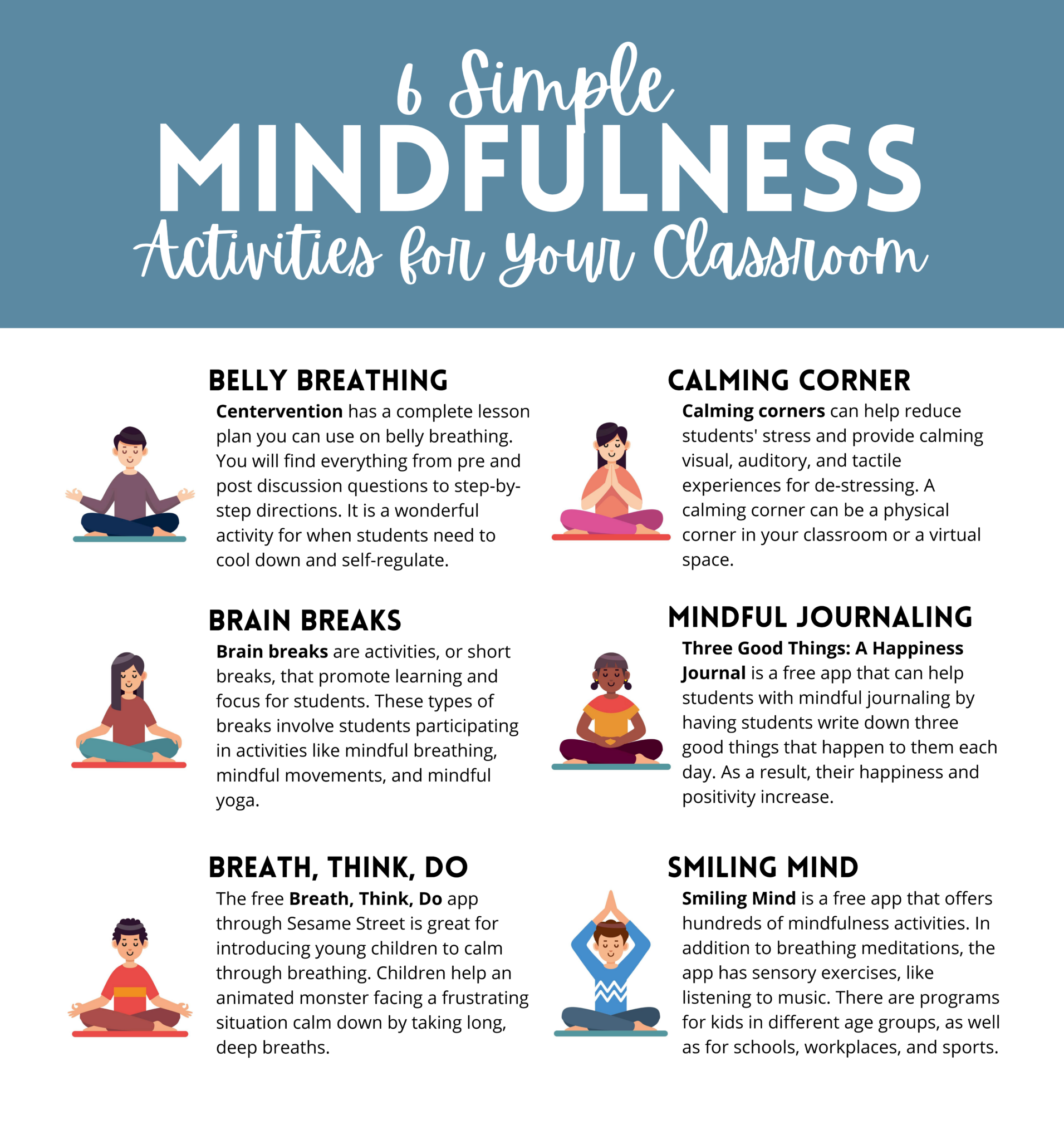
Preview the above poster on “Simple Mindfulness Activities for your Classroom”. Which one/s of these activities would you use to benefit your students the most? Why? Explain. Write a brief example of how you would use of one of these techniques in your classroom. I often use “Brain Breaks”. My 7th graders love to take short breaks from learning and sit quietly, chat, or just relax. Sometimes we use the Calm app to breath!
Assignment #9: Mindful Journaling can be seen as a practice that could work well for any age group of students. When you introduce mental or mindful journaling as a reflective practice, you can give students prompts that encourage self-awareness, gratitude, or emotional expression. Journaling not only allows students to manage their thoughts and feelings, but is also a valuable tool for tracking personal growth and personal development. This process creates a deeper bond with others and fosters learning. It gets some great thoughts out!
Think about the idea of mindful or mental journaling. Describe how meaningful you think this practice might be for your students. Comment on anything that comes to mind when students work on journaling. How might this type of journalinng allow for better self-expression? Managing of thoughts? Writing assignment? Poetry? Etc…
Assignment #10: Personal/Professional Reflection: Fostering learning through Mindfulness and relaxation is a useful tool for any educator and can definitely help your students no matter what age group. Describe how this course might better help you foster mindfulness and relaxation with your students based on the many strategies shared. Share your thoughts.
Thanks for joining my course. I hope you enjoyed it and found the information provided useful. Please contact me if you would like to sign up for other courses. Go to LIIPS.org to find a full list of all my courses.
Talk to you soon,
Kim:)