
Hi All,
Welcome and Class Description:
Thank you for joining my course! Nurturing the individual student involves inclusivity on the part of the educators. It incorporates foundations such as inspiration, creativity and building confidence. It helps educators to differentiate for their students and create a successful classroom.
Directions for your coursework:
Please complete all coursework and send all responses to me in one email or document. Please be sure to put your name and title of the course on the document (email) when sent. Please reach out to me at any time with any questions or concerns. I am always here to help and support.
The course is divided into 10 assignments that have information, links, and valuable resources on the topic. I hope you enjoy the course and find that it is helpful, and you can apply it to your teaching or educational position.
Assignment #1: Introduction: Please introduce yourself to me. What subject/area do you teach? What grade level/s? If you are not a classroom teacher, what is your position at your school? Share your thoughts on individuality and nurturing your students?
Briefly explain your current teaching situation. Share nurturing in your classroom and individuality and your thoughts on it. Discuss how you you creative an inclusive classroom.
Assignment # 2: Key Strategies for Nurturing Individuality and Inclusivity: Look over the key strategies for nurturing individuality and inclusivity.
- Build Authentic Relationships: Take time to understand each student’s strengths, cultural background, and unique interests to make them feel truly seen and supported.
- Implement Differentiated Instruction: Use varied teaching methods and materials that cater to different learning styles (visual, auditory, kinesthetic) and ability levels.
- Foster Emotional Safety and Trust: Create a space where mistakes are viewed as learning opportunities, reducing the fear of failure and boosting confidence.
- Encourage Student Voice and Choice: Allow your students to choose how they demonstrate understanding through diverse projects, such as presentations, videos, or written reports.
- Use Inclusive Language and Representation: Employ inclusive language that affirms all identities and select diverse learning materials that reflect various cultures and backgrounds.
In a brief paragraph, review the key strategies for nurturing individuals in your classroom. Discuss inclusivity and how these key strategies support your students and their diverse learning styles and needs. Choose one or two and focus on the power these strategies have in a classroom.
Assignment #3: Cultivating Creativity and Confidence: Read over how to cultivate confidence and creativity within a classroom.
- Incorporate Creative Assignments: Shift away from rote memorization towards, “suppose” or “imagine” scenarios, which stimulate critical thinking and creativity.
- Connect Content to Personal Interests: Design projects around topics that students are passionate about, such as using specific interests like gaming or sports in math and writing, as described in this Edutopia article.
- Promote Collaborative Creativity: Encourage group work that values every member’s unique contribution to a project, fostering teamwork.
- Recognize Diverse Strengths: Celebrate more than just academic success by acknowledging creativity, kindness, and perseverance.
In a brief paragraph, comment on your students and how to cultivate their creativity and how this leads to confidence in your students. Think about an assignment you could work on with your students, a project you could assign, how collaboration fosters teamwork, or celebrating the strengths of your students. Explain how one of these strategies would work best.
Assignment #4: Structural Components of an Inclusive Classroom: Read over the structural components of an inclusive classroom.
- Flexible Seating and Grouping: Regularly switch seating assignments and create flexible, small-group interactions to foster interaction and reduce social barriers.
- Utilize Universal Design for Learning (UDL): Apply UDL principles to proactively design curricula that accommodate all learners from the beginning, as noted in this blog post.
- Safe and Supportive Atmosphere: Ensure the physical and emotional environment is welcoming to all, regardless of background or ability.
Read the following structural components of an inclusive classroom. Discuss any one of the three components and how you have used it in your classroom to make your classroom inclusive. In addition, choose one of the three structural components you have never used and would like to adopt to make your classroom more inclusive. Explain.
Assignment #5:
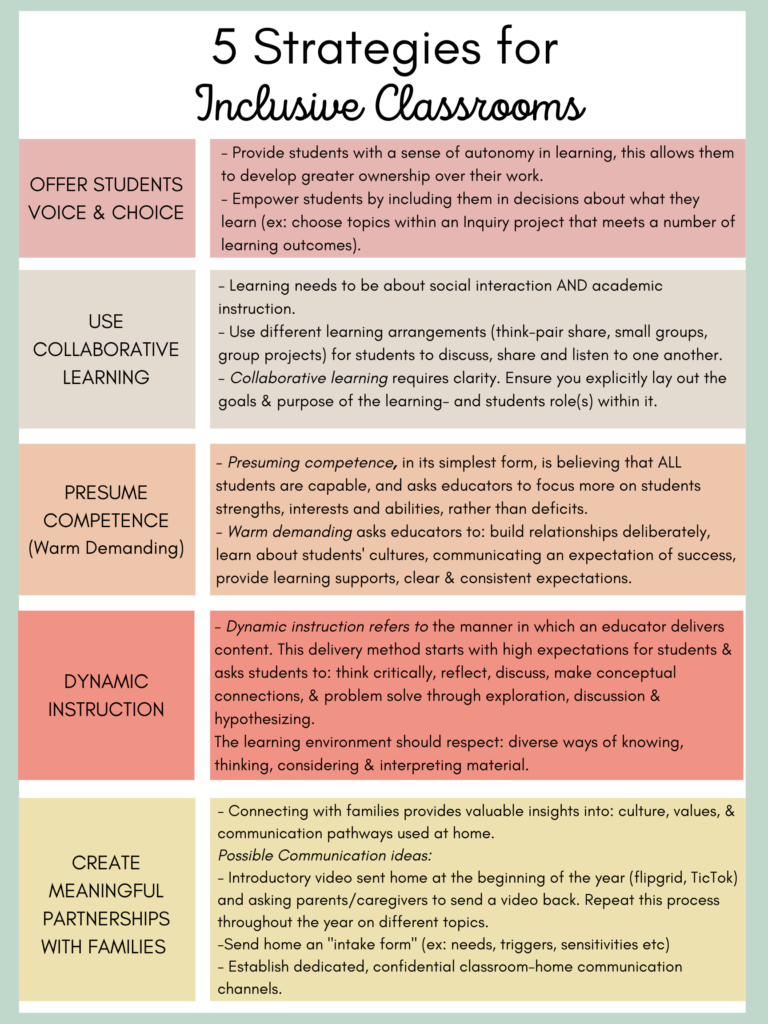
Read over the graphic of “5 Strategies for Inclusive Classrooms”. Of the 5 strategies mentioned; voice and choice, collaborative learning, presuming competence, dynamic instruction and creating meaningful partnerships with families, give an example of how you would use ONE of them in your classroom to build inclusion. For example, we have many communication channels to build relationships with families. We have Parent Square, a Principal’s Newsletter, eschool, and even a Superintendent’s Newsletter. Most of these are in English and Spanish to support the parents.
Read the following article about teaching strategies that support students’ individuality. Comment on setting up your classroom. How do you set up your classroom to reflect your diverse learning community? Think about the assignments you give, the books you read, etc… Are you flexible? Do you make you are inclusive in all that you do in your classroom? Explain.
Assignment #7: Fostering Confidence and Creativity: Look over some strategies for fostering confidence and creativity. Think about how you might use them.
1. Celebrate Diversity: Incorporate literature, artifacts, and guest speakers that reflect the diverse cultures and backgrounds of all students.
- 2. Create a Safe Space for Risk-Taking: Establish clear classroom rules that emphasize kindness and respect. A safe culture allows students to feel free to struggle and make mistakes as part of the learning process.
- 3. Use Positive Reinforcement: Recognize achievements beyond just test scores, such as strides in kindness, leadership, or personal growth.
- 4. Integrate Positive Play and Hands-on Activities: Use games and creative projects to explore complex topics, making education feel like an adventure and encouraging original thinking.
- 5. Provide Emotional Support All Around: Designate quiet nooks or calming areas for students who need space for emotional regulation.
Describe how you used or would use ONE of these strategies in your classroom to create a vibrant, dynamic academic environment where every student feels seen, heard, and valued. Explain which strategy you would use and how you would cultivate the strategy. For me, as a Brentwood teacher, I have often celebrated diversity and incorporated literature to reflect the backgrounds of my students. We have also done projects that discuss their unique backgrounds and holidays. We all learn a great deal from each other.
Read the following article on cultivating a creative mindset in students. In one line of the article it states that “creativity has to be nurtured in order to grow, strengthen and renew”. Think about yourself as an educator and how you can cultivate your own minset for your students. (I love art and always try to incorporate it into my lessons!) How can you be more creative for them? Share a lesson that you developed or a lesson you did with your students that believe was very creative. How did the students react to the creativity, and do you believe that it helped nurture them? Explain.
Assignment #9:
Watch the video about ways to make classroom participation more inclusive. Comment on any strategy or anything in the video that would work in your classroom. One strategy not in the video that I use in the classroom is a set of cards that are red, yellow and green. Each student gets a set. I have used them for many years. I connect them with a ring. I have a set for everyone in the class. When we do a lesson or a new concept, if a student understands the lesson/concept, he/she holds up the green card. If he/she sort of understands it and needs further clarification, the yellow card goes up. If a student does not understand it at all, the red card goes up. If they feel funny about holding up the card, the student will place the card on the desk in front of them. This gives me an understanding of where my students are at in the learning process.
Assignment #10: Personal/Professional Reflection: Nurturing student individuality in your inclusive classroom involves shifting your thoughts and approaches to fit the uniqueness of each student (their background, learning style, their strengths). Discuss how after taking this course you will now be able to create an environment where differences are celebrated instead of tolerated, and where you can inspire confidence and creativity for student success. Discuss your thoughts about anything regarding the course.
Thanks for joining my course. I hope you enjoyed it and found the information provided useful. Please contact me if you would like to sign up for other courses. Go to LIIPS.org to find a full list of all my courses.
Talk to you soon,
Kim:)