
Hi All.
This course will focus on communication in our classrooms. How do we communicate with our students? Do we make it fun? Do they get our sense of humor? Do they understand us and each other? We will discuss how to create a comfortable atmosphere in our classrooms where students want to communicate with each other and learn.
Assignment #1: What do you teach? What subject area and level? How do you you start the year off, and how do you explain effective communication in your classroom?
Assignment #2: What is your definition of “communication”? What does communication look like in your classroom? Give an example of a typical few minutes in your room. For example: In my classroom, my students are open and feel like they can ask any questions. I constantly say, “No question is silly.” They actually repeat me most of the time. I always try to joke and laugh. (except when I’m yelling! lol!) I hope that helps them to feel more at ease with each other.
Assignment #3:
Share ONE verbal and ONE non-verbal communication tip/skill you use that works in your classroom. For example: for me, one verbal tip I use with the students is just to say, “Ok, let’s get learning. We want to make sure we learn at least ONE thing today!” My non-verbal tip is my xylophone. When I hit it, they are totally quiet. It is soothing and relaxes them into listening up and focus!
Assignment #4:
 Read the article below “10 Fun ways to Teach Children Effective Communication Skills”. Choose ONE of the fun ways in the article that you think you could use in your classroom. Explain why you chose it, and how you would use it.
LIIPS10 Fun Ways to Teach Children Effective Communication Skillsarticle
Assignment #5:
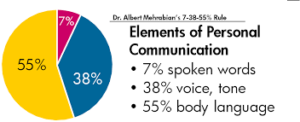
Look at the chart below about verbal and nonverbal communication. Respond with anything you would like to say. Just tell me your thoughts. Did it surprise you in any way?
Assignment #6: Read “The Path to Improving Student Communication Skills” located above. Look at the 8 tips and choose ONE tip that you think would work the best in your classroom and ONE tip that you think might not work so well. Explain why for each.
These 8 tips can help you immensely with improving student communication skills. They can be adapted for most every kind of student from kindergarten to high school. Build better speakers and writers of tomorrow by challenging your students to think critically, listen actively, and work together.
1. Watch Films That Model Conversation Skills.
Conversation is one of the most basic and essential communication skills. It enables people to share thoughts, opinions, and ideas, and receive them in turn. Although it may appear simple on the surface, effective conversations include a give-and-take exchange that consists of elements such as:
body language
eye contact
summarizing
paraphrasing
responding
Your students can learn the foundational elements of conversation by watching films or videos of these interactions taking place. Pause the video and ask questions such as, “What message is the listener sending by crossing his arms? What else can you tell by observing the expressions and body language of both people in the conversation?”
2. Use Technology.
From audiobooks to apps, there is a multitude of technological resources you can use for improving student communication skills. Students can listen to or read along with audiobooks to hear how the speaker pronounces and enunciates different words or phrases. Some great free apps that improve student communication skills are VoiceThread (which is suitable for kindergartners through adults) and Paper Telephone.
Conversations in the cloud
Transforming media into collaborative spaces with video, voice, and text commenting.
3. Reinforce Active Listening.
Communication isn’t just about speaking; it’s also about listening. Teachers can help their students develop listening skills by reading a selection of text aloud, and then having the class discuss and reflect on the content.
Active listening also means listening to understand rather than reply. Reinforce building good listening skills by encouraging students to practice asking clarifying questions to fully understand the speaker’s intended message.
Active Listening | SkillsYouNeed
(c) Copyright skillsyouneed.com 2011-2021
Active listening can be developed with practice. Listen consciously and improve your communication, avoid misund…
4. Offer Group Presentations and Assignments.
Team-building exercises can also help students sharpen both oral and written communication skills. Not only does it offer students the chance to work in small groups, thereby reducing some of the pressure, but it also gives them the opportunity to debate their opinions, take turns, and work together towards a common goal.
5. Ask Open-Ended Questions.
Because they require more than a one- or two-word response, open-ended questions are vital for inspiring discussion and demonstrating that there are multiple ways to perceive and answer a question. You might set a timer for short informal conversations and challenge students to use open-ended questions.
For example, you might show children the difference in how much more information they can obtain by asking “what did you like best about the song?” rather than simply “did you like the song?”
6. Use Tasks and Activities That Foster Critical Thinking.
Another task-based method for improving student communication skills is through critical thinking exercises. These can be done verbally or through written assignments that give students the chance to answer questions creatively using their own words and expressions. Get a head start with the communication-based critical thinking activities and games in our most popular resource, the Critical Thinking Companion.
7. Offer Reflective Learning Opportunities.
Recording students reading selected text or videotaping group presentations is an excellent method for assessing their communication strengths and weaknesses. Students can reflect on their oral performance in small groups. Then, ask each student to critique the others so that they can get used to receiving constructive criticism.
8. Find Teachable Moments.
Whatever the age group you are working with, maximize on the everyday happenings in the classroom environment. For example, if a student answers a question in a complicated way, you might ask that they rephrase what they said, or challenge the class to ask clarifying questions. If an unfamiliar word pops up in a text or on a film, pause in order for the class to search for the word in the dictionary.
Assignment #7: Verbal and Non-verbal Communications
Watch the video on Verbal and Non-Verbal Communication. Do you think this would be a helpful resource in your classroom with your students? Explain. Do you think they will understand the gist of the video?
Assignment #8: Read the article below on conversation games. What game did you like best? Why?
Classic Conversation Games to Play With Kids
By Alissa Zorn
Conversation games are a classic way to pass time. They can turn the most mundane tasks into treasured time together whether you are waiting in line at the bank, driving in the car or sharing a meal. If you’re looking for some inspiration, try these classics:
5 Classic Conversation Games
*Name Ten
Name 10 is a classic conversation game in which one person declares a category such as Fruit and the other players must come up with 10 examples of that category. The person who came up with the category gets to determine whether the examples fit.
This is similar to the game Scattergories – where teams or individuals come up with answers that fit the letter rolled on a die and the categories listed on their card. Scattergories was a hit in our household when I was growing up – great game for any family who loves word play.
*A my name is Alice
In this conversation game each person takes turns adding a name and a thing in alphabetical order. The first person might say: A my name is Alice and I like apples, and the next person could say A my name is Alice and I like Apples, B my name is Bobby and I like bears and so the game goes with each person reciting and adding to the chain.
*Fact or Fiction
In this game each person takes turns telling two things that are true about themselves and one thing that is not, the other players must then guess what is fact and what is fiction. It could be a bit harder to do with younger kids.
*I Spy This game traditionally starts with the phrase I spy with my little eye something… and then one thing is added like a descriptor or something else they see like a color. Perfect for a car trip or just sitting around!
*Questions Only
Everything anyone says must be stated in the form of a question. This conversation game is incredibly simple, has no real winner or concrete ending, it will keep you giggling and like it or not it may just crop back up hours after you thought it was finished.
Assignment #9: Write your REACTION. Write a reaction to anything in this course you think you could use or that you really believe would work for for you. Explain.
Thanks so much for taking the course.
Talk to you soon,
Kim:)