
Hi All,
Welcome and Class Description:
Thank you for joining my course! This course will discuss mindset theory for teachers and students. This learning theory, pioneered by Carol Dweck, will discuss the implicit belief about intelligence and ability and how they fundementally shape your learning behavior. These theories will lead to successful motivational and mindful techniques on the part of the students, which eventually leads to long-term mastery.
Directions for your coursework:
Please complete all coursework and send all responses to me in one email or document. Please be sure to put your name and title of the course on the document (email) when sent. Please reach out to me at any time with any questions or concerns. I am always here to help and support.
The course is divided into 10 assignments that have information, links, and valuable resources on the topic. I hope you enjoy the course and find that it is helpful, and you can apply it to your teaching or educational position.
Assignment #1: Introduction: Please introduce yourself. What subject/area do you teach? What grade level/s? If you are not a classroom teacher, what is your position at your school? Think about the term “mindset”. Describe what you think of when you hear this term. Over the years, the term mindset has become very a popular in schools. It can encompass how our students feel and how we feel. It can be “fixed” or it can “grow”.
Briefly explain your current teaching situation, share your thoughts on minset in general. Share the place that “mindset” has in schools and how it might be helpful.
Assignment # 2:
Mindset: The Foundation of Learning: Review the foundations of Mindset:
- Fixed Mindset: Believing that intelligence and talent are static traits. Learners with this mindset often avoid challenges, fear failure, and give up easily to protect their ego.
- Growth Mindset: Believing that abilities and intelligence can be developed through dedication, effort, and resilience. Learners with this mindset embrace challenges, persist through setbacks, and view effort as a necessary path to mastery.
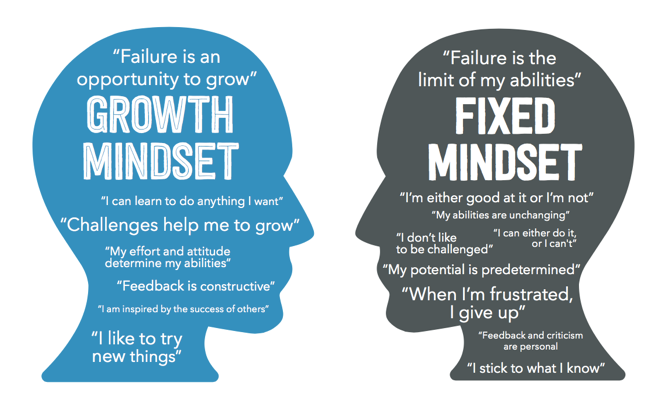
After reading these definitions, write a brief paragraph about the two different mindsets and how they are present in your students. Provide an example of a student with a fixed mindset and a student with a growth mindset. Explain the difference between these two students. Use the illustration as a guide. (In my classroom, I feel like I have more fixed mindsets than growth mindsets sometimes! It’s a struggle to get my students to see that failures are an opportunity to grow.)
Assignment #3: Motivation: The Engine of Acquisition: Read the following about motivation and how it is the engine of acquisition.
Learning requires continuous effort. Understanding what drives this effort is essential. Several prominent learning theories explain motivation:
Self-Determination Theory (SDT):
This theory suggests humans have three innate psychological needs that fuel intrinsic motivation:
- Autonomy: The desire to control your own learning path, pace, and topic choices.
- Competence: The intrinsic drive to master skills, overcome challenges, and feel capable.
- Relatedness: The feeling of connection, collaboration, and belonging within a learning community.
Goal Orientation Theory:
This framework separates goals into two distinct orientations:
- Performance Goals: Focused on external validation, such as achieving a high grade, winning a competition, or proving you are “smart”.
- Mastery Goals: Focused purely on the intrinsic value of understanding the material and growing your skill set, regardless of how it looks to others
Attribution Theory:
This theory explores how you attribute your successes and failures. If you attribute failure to a lack of ability, motivation drops. If you attribute it to a lack of proper strategy or effort, you remain empowered to try again.
Read the following three theories of motivation. After reading these theories, describe your thoughts on them and how students can benefit from them. Choose ONE from the list and explain the success a student might have while implementing this theory.
Assignment #4: Mastery: The Ultimate Destination: Read the following on the destination of mastery.
Mastery learning is an educational model that requires students to achieve a certain level of understanding (e.x., 80% to 90% proficiency) in a concept before moving on to more advanced material. Moving away from a rigid, time-based schedule ensures learners are not left with gaps in their foundational knowledge.
Deliberate Practice: Mastery isn’t just mindless repetition; it is deliberate. The core components of deliberate practice involve:
- Focusing on specific, narrow weaknesses rather than practicing what you already know.
- Actively seeking immediate feedback to correct mistakes.
- Pushing past your current comfort zone to force cognitive adaptation
After reading over the following strategies on getting to the destination of “mastery”, discuss why mastery is so important to students. Provide an example of effective situation where a student went to the ultimate destination of matery in your classroom. Explain.
Read the the following article “How to Build Intrinsic Motivation”. Write a short response on how important it is to create mastery with your students. Discuss some of the strategies mentioed in the article.
After watching the video comment briefly on the mindsets of students and their motivation to learn based on the reationships they form with their educators. Describe how motivational strategies might help students to thrive. Comment on any other parts of the video that struck you as important to your students’ cognitive develoment.
Read the following article on motivating your students as the year goes on. Share any thoughts you have after reading the article. Think about your own classroom and how you increase motivation and maintain it as the year goes on. Provide some examples of motivational techniques and strategies you use in your classroom at the beginning of the year, the middle of the year, and toward the end of the year.
Assignment #8:

Although this illustration might look a bit complicated, but look it over and check out the ladder of student and teacher motivational needs. Then, write a brief paragraph about how these needs lead to motivation in both educators and students. Explain how they can be successful it the classroom with your students and successful with teachers. Use a few of the rungs on the ladder and explain how they lead to motivation. Use examples and situations that might occur in school.
Assignment #9: 
Read the following 4 principles of learning. Look at the student-focused learning approaches (orange) and the instructor-focused learning approaches (blue). Describe the different learning theories and which ones you have used in your classroom. Explain how Behaviorism, Cognitivism, Constructivism and Connectivism can work well in a classroom. Choose ONE or TWO to discuss, share, explain.
Assignment #10: Personal/Professional Reflection: Learning requires an interplay of mindset (a belief in growth), motivation (drive and intention), and mastery (the deliberate process of deep skill acquisition). Together, These elements transform education and learning from passive memorization into an active, lifelong pursuit of excellence. Describe how this course and the theories presented are applicable to your classroom. How might you better help your students with mindset, motivation and mastery now that you taking this class. Share your thoughts.
Thanks for joining my course. I hope you enjoyed it and found the information provided useful. Please contact me if you would like to sign up for other courses. Go to LIIPS.org to find a full list of all my courses.
Talk to you soon,
Kim:)