
Hi All,
Welcome and Class Description:
Thank you for joining my course! As educators, incorporating AI Literacy across the curriculum focuses on core concepts, ethical considerations and practical teaching. This course will off you the many tools to get there with your students.
Directions for your coursework:
Please complete all coursework and send all responses to me in one email or document. Please be sure to put your name and title of the course on the document (email) when sent. Please reach out to me at any time with any questions or concerns. I am always here to help and support.
The course is divided into 10 assignments that have information, links, and valuable resources on the topic. I hope you enjoy the course and find that it is helpful, and you can apply it to your teaching or educational position.
Assignment #1: Introduction: Please introduce yourself to me. What subject/area do you teach? What grade level/s? If you are not a classroom teacher, what is your position at your school? Share your experience with AI. Have they been positive or negative? Think about AI across the curriculum in schools. Does it have a place? Explain.
Briefly explain your current teaching situation, share your experience with artificial intelligence, and AI’s place across the curriculum in schools.
Assignment # 2: Thoughts on Artificial Intelligence:
“AI literacy across the curriculum involves integrating an understanding of artificial intelligence- how it works, its ethical implications, and its practical applications – into all subject areas from K-12 to all higher education. It also prepares students for an AI-driven workforce, fostering critical thinking by analyzing AI outputs, identifying bias, and treating AI as a collaborative tool.”
After reading the quote on artificial intelligence, write a brief paragraph about why you think it is important to include AI literacy in all subject areas across the curriculum. How will AI benefit your students. Explain.
Assignment #3: Key Components of AI Literacy:
Key Components of AI Literacy (K-12 and Higher Ed)
- 1. Understanding Functionality: Learning how AI systems (e.g., generative AI, algorithms) work.
- 2. Ethical & Responsible Use: Addressing AI bias, privacy, and the societal impact of technology.
- 3. Critical Evaluation: Developing the ability to verify AI outputs and recognize creative limitations.
- 4. Practical Application: Using AI tools in fields such as writing, science, and data analysis.
In a brief paragraph, describe how you believe the key components of AI literacy can truly help our students no matter the grade level or subject. Do you think that if our students truly believe how AI works and its limitations it will help them understand it better? Will they then use it more responsibly? More effectively?
Assignment #4: https://www.edutopia.org/article/ai-literacy-students/
After reading the article about guiding students to develop AI literacy, think about our conference days or our many teacher trainings. How could we better integrate AI literacy into these trainings? (Consider the article’s emphasis on modeling responsible AI use, fostering critical evaluation of AI-generated content, and providing hands-on exploration opportunities for students). In my school, we have started to discuss artificial intelligence and its uses during our faculty meetings. I was a bit unsure about this at first but then realized that it might help me in the long run to help my students. Thoughts?
Watch the following video on ChatGPT and its use across curriculums. After listening to Daniel, what were your thoughts on whether or not some of the uses were helpful to students or were a crutch in the learning process. Comment.
Assignment #6:
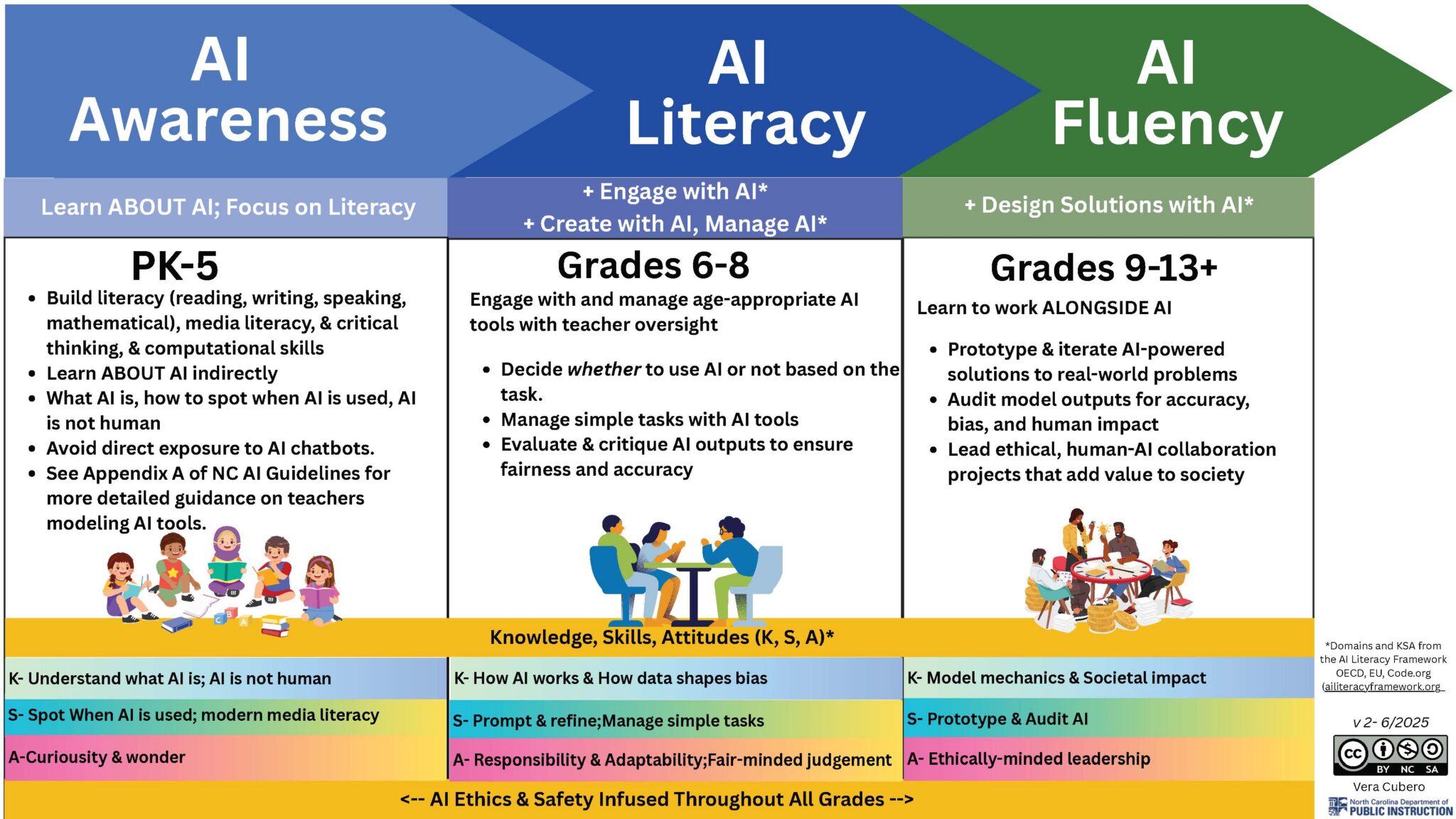
Preview the follow graphic on AI Awareness, Literacy and Fluency. Then, comment on each level of learning and the focus and understanding that artificial intelligence plays for that level. Do you think each level is accurate in its focus? Be specific on why or why not.
Read the article about AI use and worries that teachers have. Think about the concern that was expressed in the article regarding adults and AI and the decisions that adults make. Do you believe that many adults that use arificial intelligence use it effectively, productively and safely? Explain. Do you think educators using AI are “hypocrites” like the student in the article stated? Explain.
Assignment #8:

Look at the following picture above. I happen to totally love it! Write a paragraph describing your thoughts on artificial intelligence and the following picture. Could you use this picture for a writing assignment for your students? Your science students? Other subjects? Describe how you could use this graphic to create a short AI lesson for your students. This could be the “do now” and you could go from there. Share your thoughts.
Read the following article about building critical literacy in the age of AI and think about how students must verify truth. The article argues that in an AI‑driven world, students must “move from consuming information to questioning it.” Drawing on the article’s discussion of “critical literacy, lateral reading, and the limitations of AI tools”, explain why this shift is necessary and how it prepares students to navigate an information landscape increasingly shaped by AI‑generated content. Explain your thoughts.
Assignment #10: Personal/Professional Reflection: Artificial Intelligence in education and teaching literacy across the curriculums takes much practice and work on the teacher’s part. Educators must explain many of the AI concepts, tools, and real-world applications. Describe how taking this coursemight better help you use artificial intelligence more effectively with your students or with your students based on the many strategies shared. Discuss.
Thanks for joining my course. I hope you enjoyed it and found the information provided useful. Please contact me if you would like to sign up for other courses. Go to LIIPS.org to find a full list of all my courses.
Talk to you soon,
Kim:)