
Hi All,
Welcome and Class Description:
Thank you for joining my course! Being an educator in the “anxious era” takes time, tools and support. Incorporating factors such as growth vs. fixed mindset beliefs, peer/teacher connections and student-led instruction are just a few foundations to create a successful, calm classroom.
Directions for your coursework:
Please complete all coursework and send all responses to me in one email or document. Please be sure to put your name and title of the course on the document (email) when sent. Please reach out to me at any time with any questions or concerns. I am always here to help and support.
The course is divided into 10 assignments that have information, links, and valuable resources on the topic. I hope you enjoy the course and find that it is helpful, and you can apply it to your teaching or educational position.
Assignment #1: Introduction: Please introduce yourself. What subject/area do you teach? What grade level/s? If you are not a classroom teacher, what is your position at your school? Share your thoughts on the post COVID era we find ourselves in. Do students seem more anxiousthan they were in past years. How would you define our “anxious era” or the “anxiety ” that some of our students seem to have developed over the past few years?
Briefly explain your current teaching situation. Share your thoughts on your students and anxiety in your classroom or in their lives. Explain your thoughts on the post-COVID era.
Assignment # 2: The Anxious Generation by Jonathan Haidt argues that the rise of smartphones and social media has caused a mental health crisis in adolescents by “rewiring” childhood away from play-based development and into a phone-based one, leading to increased anxiety, depression, and loneliness. Haidt claims this shift, occurring around 2010-2015. He states that it has deprived children of crucial real-world experiences, causing harm through sleep deprivation, social isolation, and addiction, and he calls for a return to older parenting models with delayed phone access and more unsupervised play.
Core arguments: There are many arguments of The Anxious Generation.
1. “Great Rewiring”: A shift from a “play-based childhood” (pre-2010) to a “phone-based childhood” (post-2010) has fundamentally altered adolescent development.
2. Four Harms: The phone-based childhood creates four key harms: sleep deprivation, social deprivation, cognitive fragmentation, and addiction.
3. Gender Divide: Social media harms girls more (leading to anxiety, eating disorders) while boys withdraw into virtual worlds, impacting their development.
4. Overprotection vs. Under-protection: Adults overprotected children in the real world (reducing play) while leaving them unprotected in the online world.
In a brief paragraph, review and address the core arguments of The Anxious Generation. Choose one or two of these core arguments and focus on the power they have over the generation of today.
Assignment #3: Proposed solutions: Look over the proposed solutions for dealing with the anxious generation.
- 1. Delayed Phone Access: Delay giving children smartphones until at least high school.
- 2. More Play: Reintroduce more free, unsupervised play in the real world.
- 3. Government Action: Implement laws to restrict social media access for minors.
- 4. Community Effort: Calls for action from parents, schools, universities, and governments to create healthier environments.
After reviewing the proposed solutions for the anxious generation comment on whether or not any of these solutions would actually work. Think about not giving a student a phone until high school or more unsupervised play. Share your thoughts on a solution that might work best for you as a parent or you as an educator.
Assignment #4:
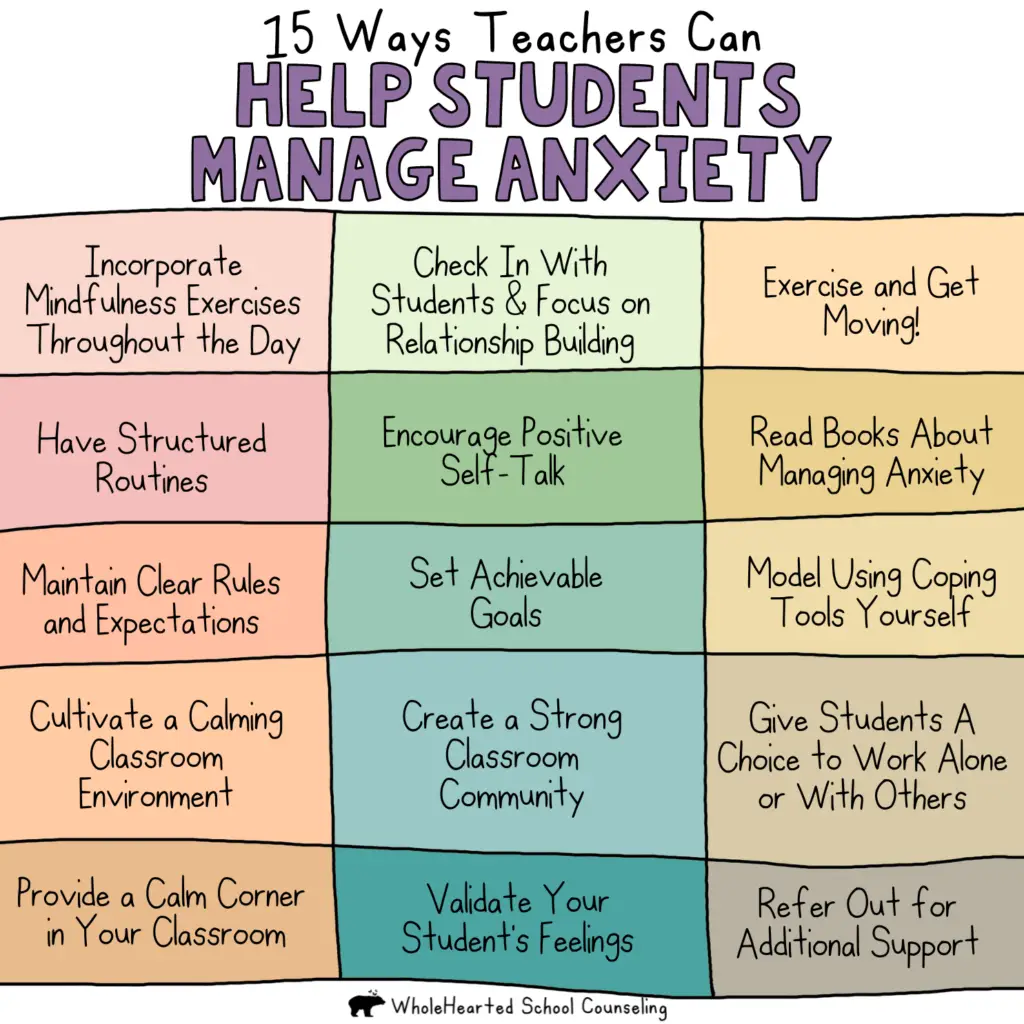
Read the following graphic on 15 ways teachers can help students manage anxiety. Discuss at least one or two of the 15 components and how you could use it/them in your classroom to manage student anxiety. In addition, explain how you could use one of these in your classroom with your current students. For example, with my students we create a strong classroom community from the beginning. We feel like a family and sometimes act like a fighting family! LOL! I think feeling comfy around each other reduces anxiety.
Read the following article about strategies to strengthen student resilience. React in a short response to the article about how educators can use these strategies to help students cope with setbacks and frustration. Are these strategies helpful and can they be used with all levels of students? Explain.
Assignment #6: Key Strategies for Building Resilience: Read the following about key strategies for building resilience.
- Normalize “Productive Struggle”: Create a classroom culture where mistakes are viewed as necessary for learning rather than failures. Use phrases like “this is supposed to be hard” to encourage students to be persistence.
- Foster Positive Teacher-Student Relationships: Establish trust by showing genuine care and interest in students. This makes them feel safe, supported, and more willing to take risks.
- Implement Social and Emotional Learning (SEL): Teach students to identify and label emotions, and provide techniques like deep breathing, mindfulness, or “five-breath resets” to manage stress.
- Praise Effort and Process: Focus praise on hard work, strategies used, and perseverance, encouraging a growth mindset rather than praising innate intelligence.
- Develop Goalsetting skills: Encourage students to set their own academic or personal goals, breaking them down into manageable steps, which fosters a sense of agency.
- Model Vulnerability: Teachers can share their own mistakes and how they worked through them, which helps students learn from setbacks and reduces the fear of failure.
- Build Peer Support Networks: Utilize collaborative work and peer check-ins to encourage students to share struggles and brainstorm solutions together.
- Reframe Affirmations: Shift from generic praise to personal “Affirmation Challenges,” where students reflect on their own strengths.
Read the following key strategies for building resilience. Comment on one or two of these strategies. Think about the power of resilience and how these would work with your classes. Explain how one or two of these key strategies could be used. In my classroom, we often build peer support networks. We do a lot of collaborative work and check-in frequently with each other on our learning process. We brainstorm together before a new unit and share our thoughts.
Assignment #7: Read over the following…
Tools for Awareness and Resilience include:
1. Mindfulness meditation- mindfulness practice
2. Journaling- gratitude journaling in class
3. Cognitive reframing- changing negative thinking to more constructive thinking
4. Building social connections to navigate adversity- building a strong support network and fostering relationships
Key strategies involve:
1. Nurturing physical health- sleep, physical activity, nutrition
2. Setting goals- establishing manageable steps to move forward
3. Fostering optimism- connecting with thoughts that bring joy (positivity jar)
4. Practicing self-care to “bounce forward” challenges
Read through all of the following tools for awareness and resilience with your students and thekey strategies that they involve. Think about how many of these can be utilized throughout a week of teaching. Write a brief example of how these can be used in a single classroom in a week’s time to bring awareness and resilience to your students. What strategies would you use? Why? Explain how they would benefit your students and your teaching atmosphere?
Assignment #8: Read over the following strategies for educator support.
Educator support for students involves holistic, multi-tiered approaches focusing on academic, social-emotional, and mental health needs. Effective strategies include fostering safe environments, utilizing trauma-informed teaching, offering mentorship, and enabling student-led learning. Collaboration with staff and families is key to providing tailored resources for student success. Many of these support systems/tools are put in place to help teachers focus on SEL and educational needs for positive learning with their students.
Some Key educator support strategies include:
- Trauma-Sensitive Instruction: Recognizing trauma’s impact, fostering a safe space, and building genuine relationships.
- Academic Supports: Tutoring, mentorship, student-led conferences, and individualized accommodations (IEPs).
- Social-Emotional Learning (SEL): Integrating mental health supports, such as check-ins or sensory tools, to help students thrive.
- Active Engagement: Using techniques like “looping” (teachers moving up with students) and encouraging student voice to foster belonging.
- Community Resources: Connecting with outside organizations and utilizing outside intervention systems that may help your students. Also, organizations like the NEA (National Education Association) advocate for educators and support staff (counselors, professionals) to reduce burnout and improve student outcomes overall.
Think about yourself and your teaching over the years. Even if you have not been teaching that long. Have you had to collaborate with families or use any outside support to help your students? If so, what support systems have you used? Are there any support systems on this list that you feel would truly benefit your students. Explain in a brief paragraph. For example, I have never “looped” with my students, but one year we decided to try it (with a math teacher), and it was awesome! Since the students had built a great relationship with the teacher, staying with that teacher for another year continued a safe and positive environment where they all thrived!
Read the following article about teachers refocusing and calming. There are many apps for mindfulness and refocusing your energy back into your classroom; apps that help you teach and help with your own social-emotional well being. Comment on any of the suggested apps mentioned. Do you use any mindfulness apps in your classroom or at home for calming yourself? One app I do not see on the list is the Calm app. I use this all the time with my students in the classroom and for myself to relax at home. Check it out and comment!
Assignment #10: Personal/Professional Reflection: Teaching in an anxious era requires prioritizing a teacher’s well-being through strict boundary-setting, cultivating self-compassion, and building supportive colleague networks to combat burnout. Discuss how after taking this course you will now be able to navigate your teaching in the anxious era. Discuss your thoughts about anything regarding the course.
Thanks for joining my course. I hope you enjoyed it and found the information provided useful. Please contact me if you would like to sign up for other courses. Go to LIIPS.org to find a full list of all my courses.
Talk to you soon,
Kim:)