
Hi All,
Thank you for taking the course! In this course we will discuss self-awareness and self-advocacy skills for our students. How do we teach them to be more self-aware? How do we teach them to advocate for themselves?
Assignment #1: Define self-awareness. What is is to be self-aware? Write about how you feel in your classroom and what your students need to be self-aware. Do you think our students have a difficult time with this concept?
Assignment # 2:
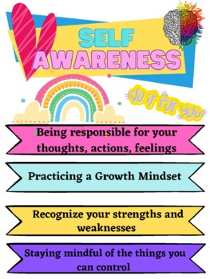
Read the chart above and the aspects of self-awareness. Touch on all of these aspects and how they help you as a teacher and how they help students in the classroom.
Assignment #3: When your students write and do projects, they need to be self-aware and reflective. Read over the article on how to implement a strategy for modeling your students to success in this area. Comment on “Reflection” in general and/or any of the tips you felt would help you in your own classroom.
https://fe.prod.glef.io/blog/reflection-assessment-empowerment-self-awareness-james-kobialka
Assignment #4:
https://www.edutopia.org/blog/8-pathways-metacognition-in-classroom-marilyn-price-mitchell?view=Grid
This article deals with metacognition and nurturing self-awareness in the classroom. Read over the 7 Strategies that Improve Metacognition. Comment on anything. I was immediately drawn to the strategy that stated, “students need practice recognizing what they don’t understand”. I thought about the students in my classes and how they are often confused. Once they realize what they are confused about and develop a strategy to learn it, they feel great about themselves. They also learn that others are confused and it’s totally ok to feel that way.
Assignment #5:
Let’s move to self-advocacy. Although self-advocacy will look different from person to person and may mostly be associated with people who have particular conditions or disabilities, it is something that everyone can learn, practice and encourage in others. For as long back as I can remember I could not speak up for myself. I am 4’ 10” and was scared to tell anyone, especially teachers, what I needed! I guess I understood my values and my needs (or maybe not) but was so afraid to let them out. As a teen I started falling into place. I realized that “the squeaky wheel gets the oil” and if I wanted something I should speak up. My Italian parents helped me to do it! What was self-advocacy like for you as a child and young adult? Share your experiences and your journey.
Assignment #6:
Tell a story about how you had to be an advocate for your own child, someone close to you, or for a student.
For me, it was my son. I realized from the time he was very young that he needed some extra attention. In pre-school he was very angry, (he even threw a chair at one of the teachers). I eventually got him tested which proved him to have ADHD and he was placed in a different part of the pre-school class. This totally helped! He was in Special Education in kindergarten and then gradually moved out. At this point just ending 9th grade, he will be out of Resource Room but still have his 504 Plan for extended time and breaks. He has come a long way.
Assignment #7:
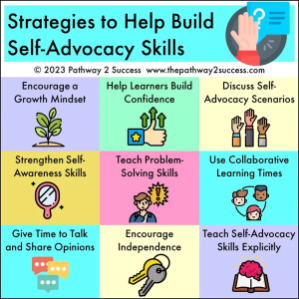
These are some strategies to help build self- advocacy. Look over the chart and think about ways you do this already in your classroom and your school. Comment on anything. Other strategies include: Learning interest inventories, exit tickets, progress monitoring, peer and self-assessment. Also, educational tools you can use to enhance self-advocacy are: manipulatives and graphic organizers, audio recording, choice boards, learning menus, and the use of timers. Personally, I like the use of a timer, and I think “turn and talk” works really well for 7th graders. They love sharing personal stories.
Assignment #8:
As stated earlier, when a student finally understands his/her strengths you can encourage them to advocate for themselves and meet their own needs. Some self-regulation tools that can help you better support your students are:
- Mindfulness routines (short breathing or focusing activities)
- Making real-time adjustments based on body feedback (taking a break, asking for help, etc.)
- Providing strategies for managing physical or kinesthetic energy (allow use of soft fidgets, standing, moving while processing, etc.)
- Using positive self-talk (provide prompts or visual reminders for context)
- Supporting students with setting realistic and measurable personal goals
- Helping students with the process of self-reflection
Think about your students no matter what their age/grade is. How can the use of any of these help? Do you use these in your room already? Relate a short story about how you used one of these already. Are there any that you will now use?
Assignment #9:
I found an article through my research on having “authentic student participation” in their own IEP meetings. It made me think about how in our school we ask students to join our SIT (School Improvement) Team. This way they have a say in school events. What are your thoughts on students’ voices and input on their own IEP meetings? Would it give others a different perspective on what their needs are? Would it help with their accommodations and goals? Share.
Assignment #10: Reflection: Please reflect on the course and how you could use any of the strategies or techniques to teach students self-awareness or self-advocacy. Comment on anything you took away from the course.
Thanks for joining in! Talk to you soon,
Kim:)